

Today’s fast-evolving workplaces are driven by hybrid work models, rapid technology adoption, and frequent team reorganizations. However, due to their rigid layouts, performing the adds, moves, or changes (AMCs) necessary on a traditional fixed-power system can quickly create bottlenecks and costly disruptions for owners, tenants, and facility teams.
This system is typically hidden within the walls or in the plenum space above the finished ceiling and uses a network of conduits or electrical metallic tubing (EMT) to carry various types of wiring or cables from one point to another. The most common fixed-power systems use one or more of the following:
Rigid Metal Conduit/Galvanized Rigid Conduit (RMC/GRC) features threaded, heavy-duty, steel tubing designed for maximum physical protection and structural support of electrical wiring. It is primarily used in harsh industrial, commercial, and outdoor environments due to its high resistance to corrosion and physical damage. For maximum protection in commercial and industrial settings.
Flexible Metal Conduit (FMC) and Liquidtight Flexible Metal Conduit (LFMC) are protective, flexible raceways for electrical wiring. FMC is designed for dry, indoor locations, while LFMC features a thermoplastic cover for wet, oily, or outdoor environments. Both options can accommodate tight bends, absorb vibration, and require secure, code-compliant support.
PVC Conduit or Rigid Nonmetallic Conduit (RNC) is a durable, lightweight, and non-conductive plastic raceway used to protect electrical wiring. Made of polyvinyl chloride, it is highly corrosion-resistant, ideal for wet, underground, or chemical-heavy environments. It is commonly used in Schedule 40 (standard duty) and Schedule 80 (extra-heavy duty) for residential and commercial applications.
Electrical Nonmetallic Tubing (ENT) is a flexible, corrugated, blue or gray PVC raceway, often called a “Smurf tube,” used to carry electrical wiring in walls, floors, and non-plenum ceilings. It is corrosion-resistant, flame-retardant, and hand-bendable, offering a lightweight, cost-effective, and fast-installation alternative.
Based on the specific usage needs, three types of wiring are commonly used with the systems listed above.
Thermoplastic High Heat-resistant Nylon-coated (THHN) is rated for 600V and up to 90°C, making it ideal for general-purpose uses such as machinery, control circuits, lighting, and appliances.
THWN wire (Thermoplastic Heat and Water-resistant Nylon-coated) has the same voltage and temperature rating as above, but is also approved for wet and damp locations.
Metal Clad (MC) cable is an armored electrical cable featuring insulated copper or aluminum conductors wrapped in flexible, interlocking metal tape of steel or aluminum
However, by replacing obsolete rigid-power systems with a modular, adaptive bus system hidden beneath a low-profile raised access floor, commercial properties can gain unprecedented flexibility for AMCs or complete reconfiguration. This allows owners and facility teams to quickly and cost-effectively address futureproofing concerns while simultaneously extending the property’s lifecycle.
Embedded Electrical Access via Low-Profile Raised Floors
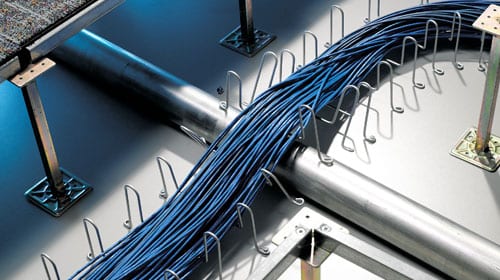
Low-profile raised access floors, like the Gridd® Adaptive Cabling Distribution® System, create a hidden, organized underfloor cavity (1.6 to 2.75” in height) by installing modular steel assemblies on top of the existing floor for data and voice cabling needs. This system installs without any special tools or fasteners and can be disassembled and moved to another location, if necessary. Gridd is available in three weight classifications and is fully backward and forward compatible with all Gridd systems installed over the last 30 years.
When combined with Gridd Power®, owners and facility teams can integrate in-floor power distribution directly into the building’s subfloor, providing on-demand power anywhere on the open plan without visible cables, poles, or hardwiring. Gridd Power features a 50-Amp, 3-Phase, 208V modular bus bar system (up to 18 kW per track) that uses snap-together 4-ft and 8-ft power tracks with tap-off points every 12 inches, quick-connect whips, feed units, and tap-offs. Gridd Power fits neatly into floor channels to create a seamless, highly flexible power delivery system for any commercial space.
The Gridd system complies with the intent of the provisions of the following codes and regulations certified by an IAPMO UES Evaluation:
2021, 2018, 2015, 2012, and 2009 International Building Code® (IBC)
2013 Abu Dhabi International Building Code (ADIBC)
2023 City of Los Angeles Building Code (LABC)
2022 California Building Code (CBC)
GreenSpec-listed
BuildingGreen-approved
How EEA Enhances Workplace Flexibility
Gridd eliminates the need for cumbersome cable trays, overhead drops, power poles, core drilling, and hardwired conduits by replacing them with pre-configured, tool-free modular components. The modular snap-together tracks and quick-connect components enable in-house teams to move, add, or reconfigure power without electricians, extended downtime, or new CAD drawings.
Gridd’s future-proof design allows teams to integrate emerging tech as needed by the client or their changing business model. High-capacity devices (up to 18kW) such as computers, monitors, AV equipment, charging stations, and Internet of Things (IoT) devices can be added, removed, or relocated without the need for or the inconvenience of traditional construction methods or costs.
As changes become necessary, facility teams start by removing the finished flooring, usually carpet tiles or Luxury Vinyl Tile (LVT). Next, they lift the access panels, which install without any special fasteners or tools, to re-route power whips or tap-offs, or a connection point, and replace the floor finish—changes happen in minutes rather than days.
Embedding electrical access within a low-profile raised floor turns the typical power infrastructure from a design constraint into a strategic enabler, delivering speed, agility, and cost control in dynamic workplaces. As “the office” continues to evolve with AI, hybrid work models, and smart technology, embedded modular power will be essential for staying competitive and responsive, while extending the property’s life cycle. To learn more about Embedded Electrical Access for your clients or next project, please contact a Gridd advisor.

