

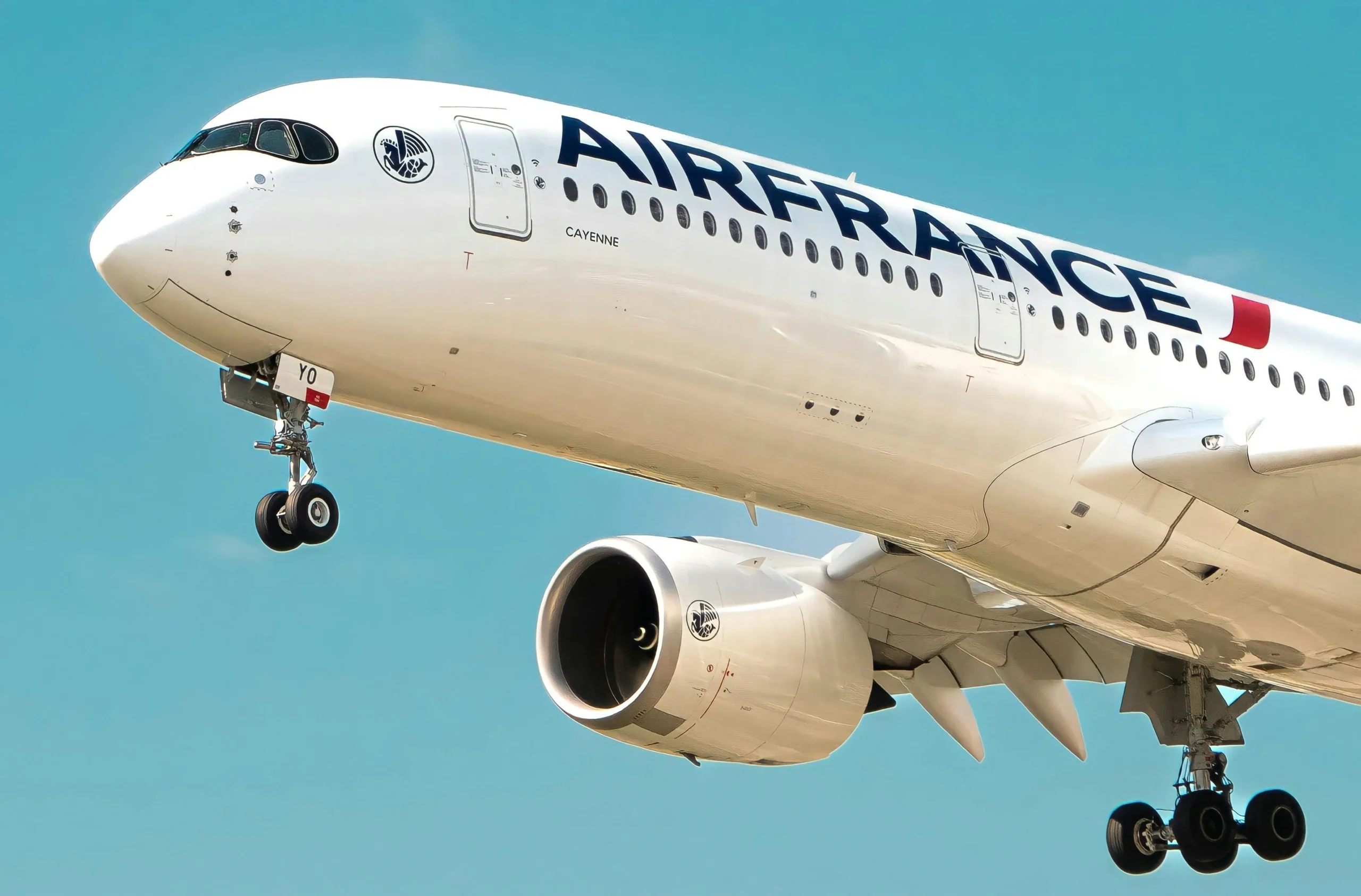
Arriving late is one thing. Arriving late and not knowing you were entitled to €400 or €600 for the inconvenience is another. With Air France, that second scenario plays out thousands of times a year — passengers absorb the delay, accept whatever the airline offers at the time, and move on without ever filing a claim they had every right to make.
This guide is the practical version: what you need to know, what you need to do, and how to get the compensation paid without spending weeks navigating an airline’s customer relations department.
Does Your Air France Delay Qualify?
Not every delay triggers a compensation entitlement under EU261, so the starting point is establishing whether your specific disruption falls within scope.
EC Regulation 261/2004 applies to Air France — a French, EU-licensed carrier — on all flights departing from EU airports and on flights arriving into the EU from elsewhere when Air France is the operating carrier. That covers the vast majority of the airline’s network: European routes, transatlantic services, long-haul connections to Africa, Asia, the Indian Ocean, and the Americas.
Four conditions need to be satisfied for a delay claim to be valid. First, the flight must fall within the regulation’s geographic scope. Second, you must have arrived at your final destination more than three hours after the scheduled arrival time — measured when the aircraft doors open at the gate, not when the plane lands. Third, the disruption must have been caused by something within Air France’s operational control rather than a genuine extraordinary circumstance. Fourth, you must have held a confirmed booking and checked in on time for the flight.
If all four apply to your situation, you have a valid claim.
What You Can Expect to Receive
Compensation amounts are fixed by the regulation and determined entirely by flight distance. Ticket price, fare class, and the specific circumstances of the delay have no bearing on the figure — a passenger who paid €75 for an economy seat gets the same compensation as one who paid €1,200 for business class on the same disrupted flight.
European short-haul routes under 1,500 kilometres are worth €250 per passenger. Medium-haul connections between 1,500 and 3,500 kilometres qualify for €400. Long-haul routes over 3,500 kilometres — and Air France operates one of the most extensive long-haul networks of any European carrier — are worth €600 per person.
The long-haul point is worth dwelling on. Air France flies to destinations across North America, the Caribbean, West and Central Africa, Southeast Asia, the Middle East, and the Indian Ocean. A delay of three or more hours on any of these routes puts every affected passenger in the €600 bracket. For a family of three on a delayed Paris to New York service, that’s €1,800. For a couple on the same flight, €1,200. These are meaningful sums that go unclaimed far too often.
The Extraordinary Circumstances Question — Answered Plainly
Airlines invoke extraordinary circumstances as a defence against compensation claims whenever they can. Air France does this, and it does it sometimes on grounds that don’t hold up under scrutiny.
The regulation allows the exemption for events genuinely outside the airline’s control — severe weather that directly prevents flying, widespread air traffic control strikes affecting entire regions, security threats, political instability. These are legitimate. Nobody expects an airline to pay compensation for a flight grounded by a hurricane.
What the exemption doesn’t cover is considerably more expansive. Technical faults are the biggest area of contention. Air France has cited technical issues in rejecting compensation claims for delays, but European case law — including rulings from the Court of Justice of the EU — is consistent that mechanical and technical problems are part of the inherent risk of running an airline. They only qualify as extraordinary circumstances when they involve a hidden manufacturing defect that was undetectable through any standard maintenance procedure. Routine faults, pre-flight inspection failures, component wear, and unscheduled maintenance requirements don’t meet that standard.
Charles de Gaulle Airport, Air France’s main hub, is consistently one of the busiest and most congestion-prone in Europe. Slot delays, ground handling issues, and late-arriving aircraft cascading through CDG during peak periods are operational realities — and operational realities are the airline’s problem, not the passenger’s.
Air France’s own staff strikes are another category that the airline sometimes incorrectly treats as extraordinary circumstances. European courts have established clearly that strikes by an airline’s own employees — pilots, cabin crew, ground staff — are not outside the airline’s control in the way that ATC strikes or weather events are. Passengers whose flights were delayed during Air France staff industrial action have valid claims.
A Step-by-Step Approach to Filing
Step one: Confirm the delay. Flight tracking services like FlightAware and Flightradar24 maintain historical records and can give you the exact arrival time of your flight. Compare this to the scheduled arrival time on your booking confirmation. If the gap is over three hours, you’re past the qualifying threshold.
Step two: Note the route distance. This determines your compensation amount. For most Air France long-haul routes the answer is straightforward — Paris to anywhere outside Europe almost certainly exceeds 3,500 kilometres. For European routes, the distance can be checked quickly online.
Step three: Gather your documents. Your flight number and travel date are the essentials. A booking confirmation email or boarding pass helps, but in many cases flight records can be retrieved independently. Don’t let missing documentation stop you from starting the process.
Step four: Decide how to file. This is where most people face a genuine choice.
Going directly to Air France means submitting a claim through their customer relations portal. Some passengers succeed with this approach, particularly on clear-cut cases where liability is obvious and documentation is complete. The realistic experience in more complex situations — or simply in cases where Air France decides to push back — involves slow responses, requests for additional documentation, first rejections citing extraordinary circumstances, and appeal processes that can stretch over many months. Without a solid understanding of the regulation, it’s easy to accept an incorrect rejection and walk away.
Using a specialist compensation service removes the friction entirely. These platforms assess eligibility, file the claim, handle all communication with Air France, and escalate through legal channels when the airline resists or fails to pay within a reasonable timeframe. They operate on a no win, no fee basis — no cost upfront, and nothing charged if the claim doesn’t succeed. A percentage is deducted from the compensation only when it’s successfully recovered.
Voos airline compensation service works on exactly this model. You enter your details in a few minutes, and the team manages everything with Air France directly from that point — assessing rejections, challenging extraordinary circumstances defences that don’t hold up, and pursuing legal action when necessary without requiring further input from you.
Starting an Air France delay compensation claim requires your flight number and travel date at minimum. A booking confirmation helps but isn’t always essential.
The Three-Year Limit and What It Means Practically
EU261 claims can be filed up to three years after the date of the disrupted flight in most EU jurisdictions, including France. That means Air France delays from early 2022 onwards are still potentially claimable today.
For frequent Air France travelers — particularly those who fly the airline’s long-haul network regularly — going back through old booking confirmations to identify qualifying delays is a worthwhile exercise. Each disruption is a separate claim. A single long-haul delay affecting two passengers is worth €1,200. Multiple qualifying disruptions over three years adds up to considerably more.
Things Passengers Often Get Wrong
Compensation is per passenger, not per booking. Everyone on the same disrupted flight with a confirmed reservation has their own individual claim. Sharing the compensation with others on your booking isn’t necessary — each person is entitled to the full amount independently.
Accepting meals or accommodation at the airport during a delay has no effect on your right to cash compensation. These duty of care provisions are separate obligations under EU261. Taking them up doesn’t constitute a waiver of anything.
The three-hour threshold applies to arrival, not departure. A flight that departs two hours late but makes up time in the air and arrives only 90 minutes behind schedule doesn’t qualify. A flight that departs on time but lands two hours late and then sits on the tarmac for another hour and a half before doors open — that one qualifies.
And if Air France offered you a travel voucher at any point following a disruption, don’t assume that settled your EU261 entitlement. Depending on what you agreed to, a cash compensation claim may still be very much open. It costs nothing to check.

