
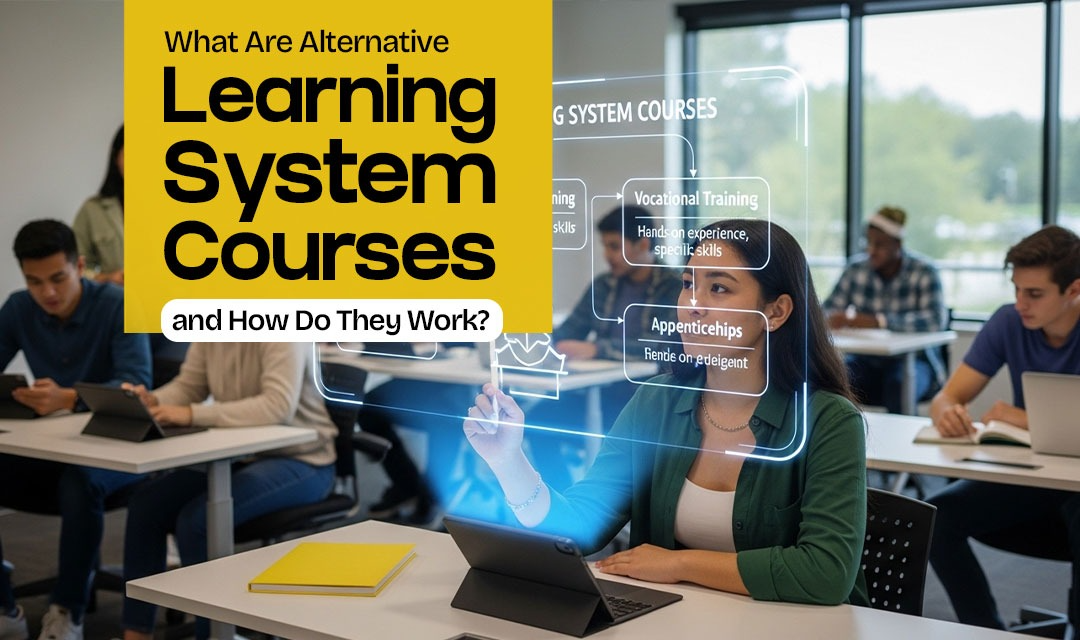
Alternative learning system courses offer a free, flexible route to earning government-recognised diplomas for those outside traditional schooling. This article explains what ALS courses are, who can enroll, how they work in practice, the types available, enrollment steps, UNESCO’s programme for girls, and how ALS compares to K-12 education.
Education should never be a rigid barrier that prevents you from reaching your true potential. If the traditional school system has failed to meet your needs, alternative learning system courses offer a flexible path to success.
Millions of learners around the world leave school early for reasons beyond their control. However, not all of them can access education due to poverty, family obligations, health issues or conflict. For these individuals, returning to a rigid classroom setting is rarely practical or even possible.
This is where alternative learning system courses come in. They provide a structured yet flexible pathway for out-of-school youth and adults to continue their education. Hence, they can earn recognised credentials and open doors that formal schooling could not.
In this guide, you will learn exactly what alternative learning system courses involve, how they work from enrolment to certification. Plus, we’ll also guide you about different programme types available and how to get started. We also cover UNESCO’s dedicated programme for girl learners and a direct comparison between ALS and K-12 education. Find out more below:
Key Points for a Quick Look
- Alternative learning system courses are government-run programmes designed for out-of-school youth, adults and dropouts. They help them earn elementary and secondary-level diplomas, without attending traditional classrooms.
- The ALS education program evolved from non-formal adult education efforts dating back to 1908, and was formally institutionalised through Republic Act 11510 in 2020.
- ALS courses serve a wide range of learners, including working adults, overseas workers, indigenous communities, teenage parents, and senior citizens.
- Learners can study through printed modules, face-to-face sessions, online platforms, radio and television instruction or blended formats.
- ALS diplomas hold legal equivalency with formal school credentials. This means passers can proceed to higher education levels or apply for government employment.
- UNESCO runs a dedicated digital skills programme for ALS girl learners, addressing gender gaps in education and technology access.
What Are Alternative Learning System Courses?

Definition of Alternative Learning System Courses
Alternative learning system courses are specialised educational programs designed for students who cannot access traditional schools. Hence, these courses prioritise individual needs by offering a tailored curriculum that addresses their challenges simultaneously. Studies confirm that around 1.2 million US students drop out of high school annually. Alternative programs offer a lifeline by adapting education to these students’ lives.
Historical Background of Alternative Learning System Courses
The evolution of alternative learning system courses in the United Kingdom is rooted in the landmark Education Act 1996. Section 19 of this legislation mandated that local authorities must provide suitable education for children who cannot attend school. Over the decades, this system has turned from a basic backup plan into a sophisticated network of specialised academies. Today, most US states fund adult education and literacy programs. These include the federal Adult Education and Family Literacy Act (AEFLA) and workforce grants that support GED prep and basic skills training.
Target Students for Alternative Learning System Courses
The alternative learning system focuses heavily on adults who have faced significant barriers to education. Such an alternative learning system for out-of-school youth targets students dealing with long-term illness, mental health challenges or those at risk of exclusion. You might also find these courses ideal if you have identified special educational needs (SEN) or disabilities. Generally, the following class of students can benefit from ALS programs:
- Students who have been permanently excluded from their mainstream secondary school.
- Young people experiencing high levels of anxiety or school avoidance (EBSA).
- Adult learners who missed out on initial qualifications and need a second chance.
- Children with medical conditions that prevent regular attendance in a physical building.
- Learners from disadvantaged backgrounds who require more personalised academic interventions.
- Students with Education, Health and Care (EHC) plans who need specialist support.
How Do Alternative Learning System Courses Work?

Enrolment and Initial Assessment
First, you must find an ALS provider. Many states have workforce agencies or literacy networks that can guide you. Typically, you’ll need to meet basic eligibility: usually 16+ years old and not currently enrolled in high school (some programs require 18+). There may be residency or citizenship criteria for certain grants.
After registration, learners take the Functional Literacy Test. This assessment places you into one of three levels: Basic Literacy, Elementary, or Junior High School. Your results shape the Individual Learning guidelines to improve your coursework writing skills.
Delivery Methods and Structure
Alternative learning is not one-size-fits-all. Therefore, providers use various formats to meet learners’ needs. In-person classes are common, either in regular classrooms or special adult-education settings. These might run during the day or in evenings/weekends to accommodate work schedules. But alternative learning system courses online learning is also a big part of the system today. The table below compares typical formats:
| Format | Description | Pros | Cons |
| In-Person Class | Scheduled classes at a community college or education centre. | Personal interaction for immediate help from teachers. | Set a schedule, less flexible commute. |
| Online | Study on your own via computer/tablet. Lessons & quizzes available anytime. | Total flexibility with no travel needed. | Requires motivation and the internet. |
| Online (Live) | Virtual classroom (Zoom/Teams) at set times. | Interactive and flexible location. | Still fixed times; tech needed. |
| Hybrid | A mix of online study and occasional in-person tutoring. | Balance of flexibility and support. | More coordination (both online & campus). |
Monitoring Progress and Certification
Throughout the course, progress is tracked via quizzes, assignments, or classroom tests. In fact, many ALS programs use specialised curricula with built-in tests to measure improvement. On top of that, teachers and tutors give feedback on assignments, so you know when you’re ready for the final exam.
ALS Accreditation and Certification Process
During study: instructors verify attendance and course completion (some programs require a minimum of 12 instructional hours, as Virginia’s adult ed does.
- Post-study exam: register online (e.g. via GED.com) to take tests (these cost around $36-$40 per section, though fee waivers may be available).
- Credential: Earn the High School Equivalency Diploma (GED, HiSET, etc.), which is then a government-recognised credential.
- Providers also often offer accreditation guidance. For example, Texas lists approved online schools that issue diplomas, and Florida emphasises that GED diplomas are state diplomas.
Types of Alternative Learning System Courses

- Basic Literacy (Adult Basic Education): These courses teach fundamental skills (reading, writing, basic math). Often labelled ABE (Adult Basic Ed), they help learners catch up to a 5th-8th grade level.
- Secondary Level (High School Equivalency Prep): ALS elementary and secondary programs are the core. Here, classes focus on the high school curriculum so students can pass equivalency exams. Subjects include Mathematics, Science, Social Studies, and Language Arts.
- Senior/Advanced: Some programs go beyond high school content. This ALS senior high school program might offer vocational training, career certifications, or college-level English/math prep.
- Specialised Needs Programs: Certain courses address specific learner needs. This includes alternative education for students with disabilities, programs for incarcerated or homeless learners, or intensive English literacy classes.
Free and Open Online ALS Courses
Today, many learners supplement local ALS classes with online courses or even complete entire programs digitally. Several platforms offer free alternative learning system courses. The table below lists some notable options:
| Platform | Example Course/Content | Format | Cost |
| USAHello Classroom | GED Preparation (Math, Science, Language Arts, Social Studies) | Self-paced online | Free |
| Khan Academy | Math, Literacy, Science tutorials | Self-paced online | Free |
| Open University (OpenLearn) | Wide range (e.g. digital skills, employability) | Self-paced modules | Free |
| Alison | Vocational & academic courses | Self-paced online | Free (certificates optional) |
| Local Adult Ed Centres | GED prep classes, basic skills | Blended (in-person/online) | Often free (grant-funded) |
Benefits of Alternative Learning System Courses
When you enrol in an ALS program, what’s in it for you? It offers an alternative learning system diploma equivalent. For example, the programme removes financial barriers entirely. On top of that, the flexible schedule means learners can study around work, family, and other responsibilities. Here are some of the key advantages of Alternative Learning System Courses:
- Flexible, Personalised Learning: You set a pace that fits your life. Classes are often small and tailored to your needs, so you can focus on exactly where you need improvement. This personal approach helps address each learner’s unique situation and learning needs.
- Second Chance for a Diploma: ALS courses directly prepare you for an officially recognised credential. Passing a GED means you leave school with a high-school equivalent certificate that colleges and employers accept.
- Improves Literacy and Skills: These programs build fundamental skills. For example, basic literacy training boosts reading levels, which in turn leads to higher earnings and lower poverty risk.
- Builds 21st-Century Skills: Modern ALS often includes digital literacy and vocational training. UNESCO reports that focused digital-skills courses helped disadvantaged female learners learn Microsoft Office and ICT basics, which raises employment chances.
- Cost-Effective and Supportive: Many programs are free or low-cost. For example, CUNY’s GED prep classes are tuition-free thanks to federal WIOA grants.
How to Enrol in Alternative Learning System Courses and Get Started?

Step 1: Find a Program
Check with your local school district’s adult education office, community college, library literacy centre, or state workforce agency. Websites like FinishYourDiploma can locate free adult education centres by ZIP code.
Step 2: Meet Eligibility
Be sure you meet the age alternative learning system course requirements. If you’re under 18, you usually need a withdrawal notice from your last school and parental consent. On top of that, you might also need to show residency (state ID) or citizenship if it’s a federally-funded program. In most cases, if you legally dropped out and want to finish, you’ll qualify.
Step 3: Documentation
Bring a valid photo ID (driver’s license, state ID, or passport). If under 18, also bring your school withdrawal form or similar paperwork. In fact, some programs might ask for your last high school transcript or proof of residence (utility bill) to establish eligibility.
Step 4: Assessment Tests
Be prepared to take an initial placement test. This usually happens on your first visit. The results determine your starting classes. There’s often a small fee, or it’s included in registration. For example, Miami Dade College’s adult ed charges $15 to take the TABE.
Step 5: Orientation
You may be invited to an orientation session. Here, staff will explain the course schedule, rules, attendance requirements, and support services available. CCNY, for instance, registers students to a waiting list and then holds orientation and placement testing before admitting them into GED prep classes.
Step 6: Enrol and Attend
Once officially registered, you will receive a class schedule. Attend regularly and complete any homework or practice tests. Communicate with instructors about any help you need. Some alternative learning system learning strands also offer online options, so you might split time between classroom and computer work.
US Universities Offering Alternative Learning System Courses
While ALS is mostly run by public and nonprofit programs, some universities and colleges also host alternative education programs. Some notable examples of the universities that offer alternative learning system courses for adults are given below:
- City College of New York (CUNY): It offers free GED/HSE preparation classes through its Continuing and Professional Studies division. This program is funded by New York State and the federal WIOA grant, making it tuition-free. It covers all five GED subjects and is open to adults (19+).
- Idaho State University (Pocatello): This organisation has a College & Career Readiness program where students prepare for the GED. In fact, ISU provides classes in reading, writing, math, social studies, and science, and offers online “fast-track” options for eligible students.
- Miami Dade College (Florida): The School of Continuing Education runs GED prep at several campuses. MDC shows how the process works (orientation, placement, low tuition), and notes that Florida GED diplomas are “just as valid” as any state diploma.
- Others: Many community colleges nationwide have adult ed departments (e.g. Mesa Community College in Arizona, Pierce College in Washington) that prepare students for equivalency exams or high-school completion. These can be viewed as part of a college’s offerings.
Eligibility Criteria for Alternative Learning System Courses
Who can enroll in alternative learning system courses? Essentially, anyone who is not currently enrolled in the formal school system. There is no upper age limit. Current formal school students are the only group explicitly barred from participating. Eligibility for ALS courses in the US typically includes:
- Age: Generally 16+ years. Additionally, some states allow 16–17-year-olds if they are officially withdrawn from high school. Other programs require you to be 18+.
- Status: Not currently enrolled in a K–12 school. You should have left or been unable to complete high school in the normal way.
- Residency: Often must be a resident of the state running the program (or a U.S. citizen/legal resident) if it’s government-funded. Check if the program is federally or state-funded and what residency proofs they need.
- Income/Need: Some grants target low-income individuals or those facing barriers (homelessness, disability, parenting, etc.). For example, WIOA youth programs require participants to be low-income and have at least one risk factor, like being a school dropout.
UNESCO Alternative Learning System Courses for Girls
Globally, UNESCO and its partners recognise the power of ALS for marginalised learners. One notable initiative is UNESCO’s training for ALS girl-learners. In 2024, nearly 100 out-of-school Filipino girls (aged 11–17) attended a two-week digital skills workshop led by UNESCO. This was part of a project to help girls in poverty finish basic education. The girls learned Microsoft Office, internet use, and other ICT basics. The training equipped them with 21st-century skills, making them more ready for jobs and higher education opportunities.
K12 vs. Alternative Learning System Courses
For many learners, the choice between K-12 and ALS depends on personal circumstances rather than programme quality. Both pathways lead to recognised credentials, but they differ significantly in structure and delivery.
In standard K–12, students attend classes daily with age-peers, following a fixed curriculum. Assessment is via letter grades. However, ALS courses are not bound by grade levels or daily schedules. Learners can be of any age (teen, adult, senior) and often study part-time. To make it clear, consider this table:
| Aspect | K–12 School | Alternative Learning (ALS) |
| Age range | 5–18 years old, divided by grade. | Often 16+ (teens and adults together). |
| Pacing | Class moves as a whole through a set curriculum. | Self-paced or small-group; learn at your own speed. |
| Assessment | Grades and state tests for each grade. | Passing one-time equivalency tests (GED/HiSET). |
| Class size | Usually, 20–30 students per classroom. | Often smaller (10–15 students), with more individual attention. |
| Support | Counsellor/teacher for general guidance. | Academic tutors and social support staff are often integrated. |
| Credential | Standard high school diploma after 12th grade. | High-school equivalency diploma (GED/HiSET) upon passing tests. |
| Cost | Public school tuition is compulsory by law. | Free/low-cost, too, but voluntary enrollment and often grant-funded. |
Conclusion
Unlike regular K–12, ALS programs meet you where you are: day or night, online or in the classroom, paying attention to your needs. We’ve covered how ALS started, who it serves (at-risk youth and adults), and the fact that these programs are officially recognised.
You now know the steps to enrol: find a local adult ed centre, complete an intake assessment, attend classes, and take the official exams. We’ve also seen the variety of courses available, basic literacy, GED prep, vocational tracks, and special programs. Don’t forget the many benefits: improved job prospects, higher earnings, personal growth, and even empowerment.
If you or someone you know needs an education reboot, ALS courses can open doors that once seemed closed. With the right program and determination, you can earn a certification and be on equal footing with high school graduates. Alternative Learning System courses are a practical lifeline for students who couldn’t complete traditional schooling. Therefore, coursework writing services offer you a flexible and personalised path to the same goal.
Frequently Asked Questions About Alternative Learning System Courses
1. Are alternative learning system courses recognised by the government?
Yes. In the U.S., ALS courses typically prepare you for a high school equivalency exam or other certified programs. The resulting credential is government-recognised. For example, a GED diploma is issued by the state and considered equivalent to a traditional high school diploma.
2. What subjects are offered in alternative learning system courses?
ALS courses cover the core high school subjects. In a GED prep program, you’ll study Language Arts (Reading and Writing), Mathematics, Science, and Social Studies. In basic literacy classes, you focus on reading, writing, and everyday math. Some programs add English as a Second Language (ESL) or digital skills (computer literacy).
3. Can students who dropped out join alternative learning system courses?
Absolutely. ALS courses are designed for students exactly in this situation. If you left school before graduation, you can enrol in an ALS program. In fact, most programs welcome learners of all ages who are not currently in high school. According to the Texas Education Agency, students at risk of dropping out can earn a high school equivalency credential through an HSEP

