

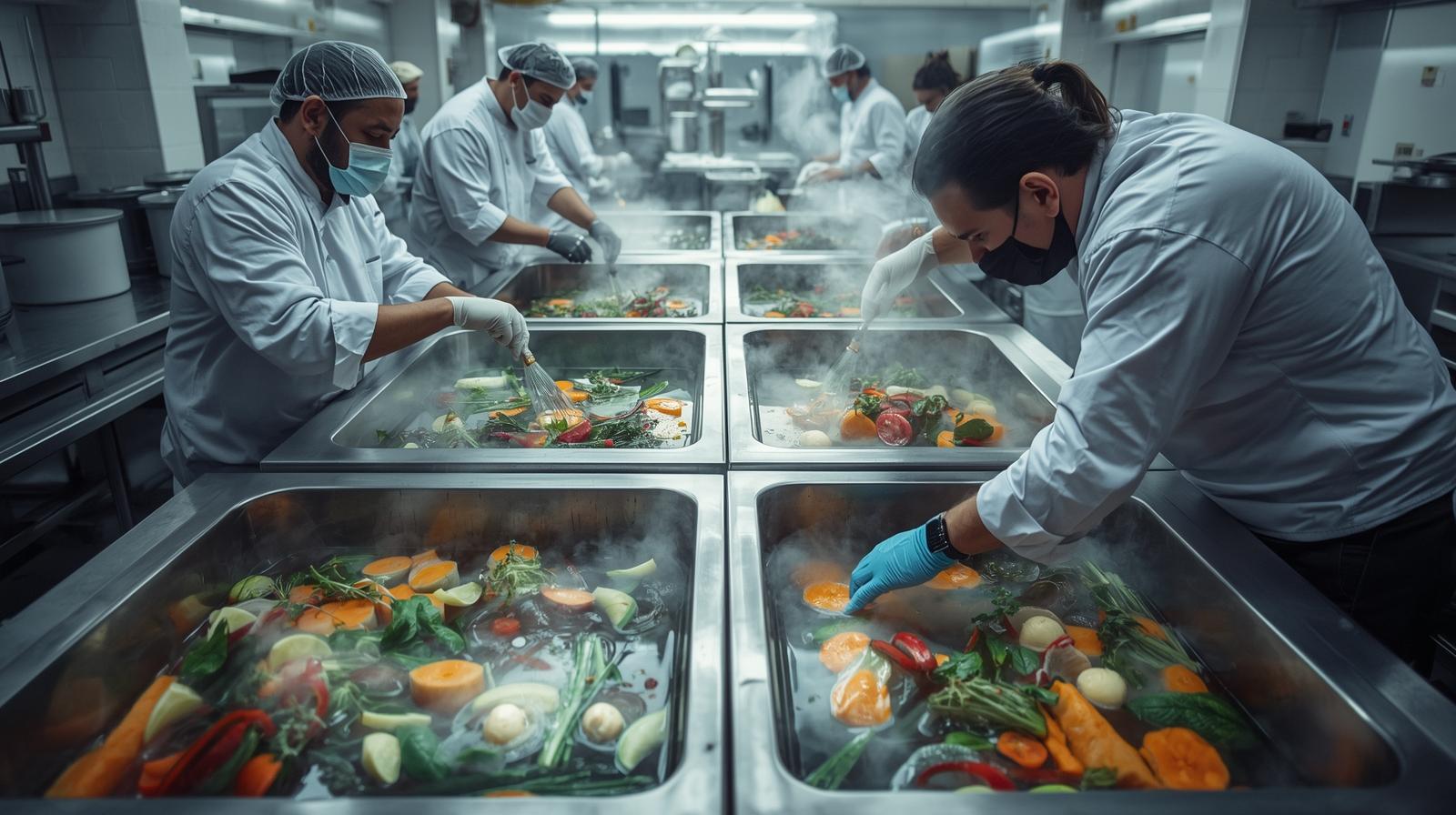
Sous vide is not a trend in hospitality. It is a process decision. Kitchens that adopt it usually do so because they need tighter control over food quality, labor, and output consistency. At its core, sous vide is a controlled cooking method where food is sealed and cooked at a precise temperature for a set amount of time. That definition is simple. The implications are not. In hospitality environments – hotels, restaurants, healthcare foodservice, event catering, and large-scale dining operations – the method changes how food is planned, prepared, held, and served.
What Is Sous Vide and Why Hospitality Uses It Differently
Sous vide means cooking food in a sealed environment at a precisely controlled temperature, usually in a circulating water bath. The temperature stays consistent. The cooking time is extended. The food never exceeds the target doneness temperature.
In traditional cooking, food is exposed to higher heat than the desired final temperature. Chefs rely on timing, intuition, and experience to stop cooking before the food overshoots. In high-volume hospitality settings, that margin for error disappears quickly. Different staff members. Different shifts. Different levels of training. Sous vide removes that variability.
This is why hospitality operators treat sous vide less as a technique and more as infrastructure.
Precision Cooking and Food Quality Outcomes
Food quality in hospitality is measured differently than in home kitchens. It is not about one perfect plate. It is about repeatability across hundreds or thousands of servings.
Sous vide directly affects food quality in four measurable ways:
Temperature accuracy
Proteins cooked sous vide reach a uniform internal temperature. There is no gradient from edge to center. Plate returns and guest complaints are decreased by this consistency.
Moisture retention
Moisture loss during cooking is reduced by vacuum sealing. Research continuously demonstrates that sous vide proteins lose less weight than roasting or grilling. Better yield and happier customers result from less shrinkage.
Texture control
Collagen can decompose over longer cooking times at lower temperatures without drying out the protein.
Flavor stability
Sealed cooking environments prevent flavor compounds from evaporating. Seasoning stays where it belongs. Aromatics infuse instead of burning off.
When these factors are controlled, food quality becomes predictable. Predictability is the real advantage in hospitality.
Why Sous Vide Redefines Food Quality in Hospitality Environments
Hospitality kitchens face constraints that home kitchens do not. Labor shortages. High turnover. Equipment limitations. Tight service windows.
Sous vide changes the pressure points.
Food can be cooked ahead of service and held safely when done correctly. Proteins can be finished quickly during peak periods without sacrificing doneness. Menu items can be standardized across multiple locations.
This matters in environments like hotels and healthcare facilities where menus must meet expectations day after day, not just on a good night.
It also matters in catering and banquets, where timing failures can ruin an entire service.
Precision cooking shifts quality control earlier in the process, when mistakes are easier to catch and fix.
Top Rated Sous Vide Systems and Commercial Considerations
The best sous vide equipment, when you’re looking online, is often geared toward home cooks. But what works in a home kitchen doesn’t always cut it in a restaurant.
Commercial kitchens have specific needs:
- They require continuous circulation.
- The equipment must be built to last, handling daily use without faltering.
- It needs to fit seamlessly with food safety standards.
- And it must be able to scale up, accommodating multiple units.
The most effective systems for the hospitality industry are chosen based on their reliability and how well they integrate into existing workflows, not just because they’re a well-known brand.
Equipment is just one piece of the puzzle. The surrounding process – packaging, labeling, storage, reheating, finishing – determines success.
Sous Vide from Concept to Commercial Success
Sous vide adoption in hospitality is rarely driven by chefs alone. It is driven by operators looking at cost control, waste reduction, and consistency metrics.
Lower protein loss improves margins. Reduced re-fires save labor. Predictable output simplifies training. These are operational wins, not culinary ones.
This is where working with an experienced sous vide company matters.
Cuisine Solutions plays a specific role in this space by supporting hospitality operators beyond the equipment or product level. The value comes from process alignment. When a hospitality operation partners with a sous vide company that understands volume, compliance, and consistency requirements, the method becomes scalable. It means the operator is working with a partner who understands how precision cooking supports menu integrity, labor efficiency, and food quality goals over time.
The difference between concept and commercial success is not sous vide itself. It is how well the system is designed to hold up under real service conditions.
Food Safety and Compliance in Sous Vide Operations
Food safety is often cited as a concern with sous vide. In hospitality, the concern is valid.
Cooking at lower temperatures requires strict adherence to time and temperature guidelines. Pasteurization curves matter. Cooling protocols matter. Storage labeling matters.
When done correctly, sous vide meets or exceeds food safety standards. When done casually, it creates risk.
Hospitality operations that succeed with sous vide treat documentation as part of the cooking process, not an afterthought.
Final Takeaway for Hospitality Operators
Sous vide in the hospitality industry is not about novelty. It is about control.
Control over temperature. Control over yield. Control over guest experience.
When precision cooking is integrated properly, food quality stabilizes. Labor pressure eases. Menus become easier to execute under stress.
When it is treated as a shortcut or trend, problems surface quickly.
The difference is planning.
For hospitality environments focused on repeatable quality, sous vide is less about how food is cooked and more about how operations are structured to support precision from prep to plate.
That is why this method continues to expand quietly behind the scenes.

