

Why the Net Matters More Than People Expect
Most new players spend their money on paddles. Makes sense, paddles are flashy and the marketing around them is loud. But the net is what turns a random patch of concrete into an actual court, and a bad one will frustrate you faster than a bad paddle ever could.
A net that won’t hold tension sags in the middle within a week. One that tips over every time a ball clips the frame turns a casual rally into a repair job. And a net that takes twenty minutes to assemble? You’ll stop bringing it to the park after the second try.
So what should you actually look for? Let’s break it down.
Regulation Size Versus Backyard Convenience
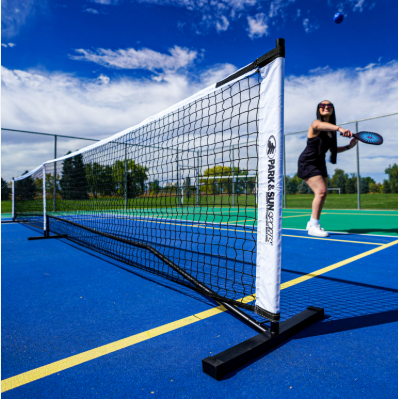
If you care about your shots translating to real court play, size matters. A regulation pickleball net set up for play measures 36 inches high at the sidelines and dips to 34 inches at the center, spanning 22 feet across, per official USA Pickleball court and equipment rules. That two inch sag in the middle isn’t sloppy manufacturing. It’s intentional, and it changes how you play the center of the court versus the sidelines.
For driveways or smaller yards, a shorter net, often around 10 feet, gets used instead. These are common in junior and starter sets. They won’t match tournament dimensions, but for kids or absolute beginners working on basic rallies, that’s rarely the point. The goal is repetition, not regulation play.
If your household includes both a serious adult player and a kid just learning the game, you may end up wanting two different sets. That’s not unusual, and several brands, PicklePro Shop among them, sell junior and full size options separately for exactly that reason.
Frame Materials and Why They Actually Matter
Here’s something a lot of buying guides skip over: the tube diameter and wall thickness of the frame tells you more about durability than the marketing copy does.
Look for base tubing in the 1.5 to 1.6 inch range with steel construction rather than thin aluminum. Powder coated steel resists dents and rust better outdoors, particularly if the net lives outside or travels between the garage and the yard often. Aluminum frames are lighter, which helps if a kid is doing the carrying, but they dent more easily and don’t always survive years of being knocked around.
Wheels matter too. If you’re moving the net across a driveway or from a car to a park, locking casters save your back and your patience. Nets without wheels aren’t necessarily worse, just less convenient for anyone hauling gear solo.
One detail worth checking before you buy: net mesh size and ply count. A 22 ply mesh with roughly 1.5 inch openings holds shape better over time than thinner, cheaper netting that stretches and sags after a season of use.
Home Setups: Driveways, Backyards, and Garages
At home, portability matters less than storage and setup speed. If the net lives in your garage and comes out on weekends, a quick connect frame with numbered tubing saves real time. Systems that assemble in under five minutes without tools tend to actually get used. The ones that require an instruction manual and forty minutes? Those end up staying in the box.
Space is the other constraint. A regulation width net needs a flat area roughly 30 by 60 feet to play properly, though plenty of families make do with less for casual rallies. If you’re working with a driveway or a small backyard, a shorter net designed for beginners fits better and doesn’t feel oversized for the space.
One thing people don’t think about until it happens: wind. A backyard net without a stable, wide base can tip in a decent gust, and that gets old fast. Wider leg spans and heavier steel bases hold up better here than compact, lightweight designs.
Park and Public Space Use: What Changes
Taking a net to a park introduces a different set of problems. You need something that survives repeated transport, sets up fast in front of impatient kids, and packs down small enough to fit in a trunk.
This is where a good carry bag actually earns its keep. A 600D oxford fabric bag with a shoulder strap holds up to being tossed in and out of a car far better than a thin nylon sack. And if the set includes court markers, even better. PVC line sets that lay flat on grass, asphalt, or a gym floor let you mark out a temporary court boundary in a few minutes, no chalk or tape required.
Weight is worth checking too. A full regulation net set with steel framing tends to land in the 40 to 45 pound range, which is manageable for one adult but not something a kid should be hauling alone. Junior sets designed for family use are usually lighter, often closer to 20 to 25 pounds, specifically so younger players can help with setup.
Rec centers, schools, and community groups looking at PicklePro Shop’s net sets or similar bundled options tend to prioritize durability over speed of setup, since the equipment gets more repeated use than a typical backyard net would.
What Comes Bundled, and Whether It’s Worth It
Complete net sets usually bundle in paddles, balls, and sometimes a bag or court markers. Whether that’s a good deal depends entirely on paddle quality, since a cheap paddle bundled in for the sake of a bigger box isn’t actually saving you money if you end up replacing it within a month.
Look for bundled paddles with carbon fiber or fiberglass faces rather than basic wood or plastic. Thermoformed construction, which fuses face and core in a single mold, tends to outlast paddles built with separate glued layers. If the set includes USAP approved balls, that’s a decent signal the manufacturer is paying attention to actual play quality rather than just packing a box full of accessories.
Price wise, expect complete regulation sets with paddles and balls to run somewhere between 150 and 250 dollars, with junior or shorter net sets typically landing lower, often in the 100 to 170 dollar range. Compare that to buying a net, two paddles, and balls separately from brands like Joola or Selkirk Sport, and bundled pricing often comes out ahead, assuming the individual components hold up.
Warranty and Support: The Part Nobody Reads Until Something Breaks
Warranty length varies more than you’d expect across brands. Some cover manufacturing defects for six months, others extend to a full year, and a few offer nothing beyond a basic return window. It’s worth checking this before you buy, not after a frame joint cracks.
Ask yourself: does the company respond to support emails in a reasonable timeframe? Do they explain what’s actually covered, or just point you to a generic policy page? These details rarely show up in product photos, but they matter once you’re the one dealing with a bent post or a torn net panel.
A Quick Checklist Before You Buy
- Regulation size (22 feet wide, 36 inches at posts) if you want real court practice
- Steel frame with wheels if it’s traveling often
- 22 ply mesh or better for the net itself
- A real carry bag, not a thin drawstring sack
- Bundled paddles you’d actually want to use, not just filler
- A warranty you’ve actually read
Frequently Asked Questions
What size net do I need for regulation play?
A regulation pickleball net measures 22 feet wide, standing 36 inches high at the sideline posts and 34 inches at the center. This is the standard used in USA Pickleball sanctioned play and most public courts.
Can I use a shorter net for backyard practice?
Yes. Many families use 10 foot portable nets for driveways or small yards. These won’t match tournament dimensions, but they’re practical for casual rallies and skill building, especially with younger players.
How much does a decent pickleball net set cost?
Complete sets with a net, paddles, and balls generally range from 100 to 250 dollars depending on size and included accessories. Junior sets tend to sit at the lower end, while full regulation sets with premium paddles run higher.
Is a steel or aluminum frame better?
Steel frames are heavier but hold up better outdoors and resist denting. Aluminum is lighter and easier for kids to carry, but it’s more prone to damage over years of regular use.
Do I need court markers if I’m playing at a park?
Not strictly, but they help. PVC court marker sets let you lay out accurate boundaries on grass, asphalt, or a gym floor in a few minutes, which is useful anywhere permanent lines don’t exist.
How long does it take to set up a portable net?
Most quality portable nets, especially ones with quick connect, numbered tubing, set up in under five minutes without tools. If a net’s instructions suggest longer than that, it’s worth reading reviews before buying.
Are bundled paddles worth using, or should I buy separately?
It depends on the paddle material. Carbon fiber or fiberglass faced paddles bundled into a set are usually fine for recreational play. If the bundled paddles are basic wood or plastic, you may want to upgrade separately once you’re past the beginner stage.

